Post
Spazio alle Radici: The First Exchange
Spazio alle Radici
The First Exchange
This digital exhibition presents the first three dialogues that emerged from the collaboration between two archives: MEET’s “Le radici del nuovo”, dedicated to innovation in art and digital culture, and Kartell Museo’s “Spazio Archivio,” which explores the innovations that have shaped the history of design
1: John Whitney – Componibili
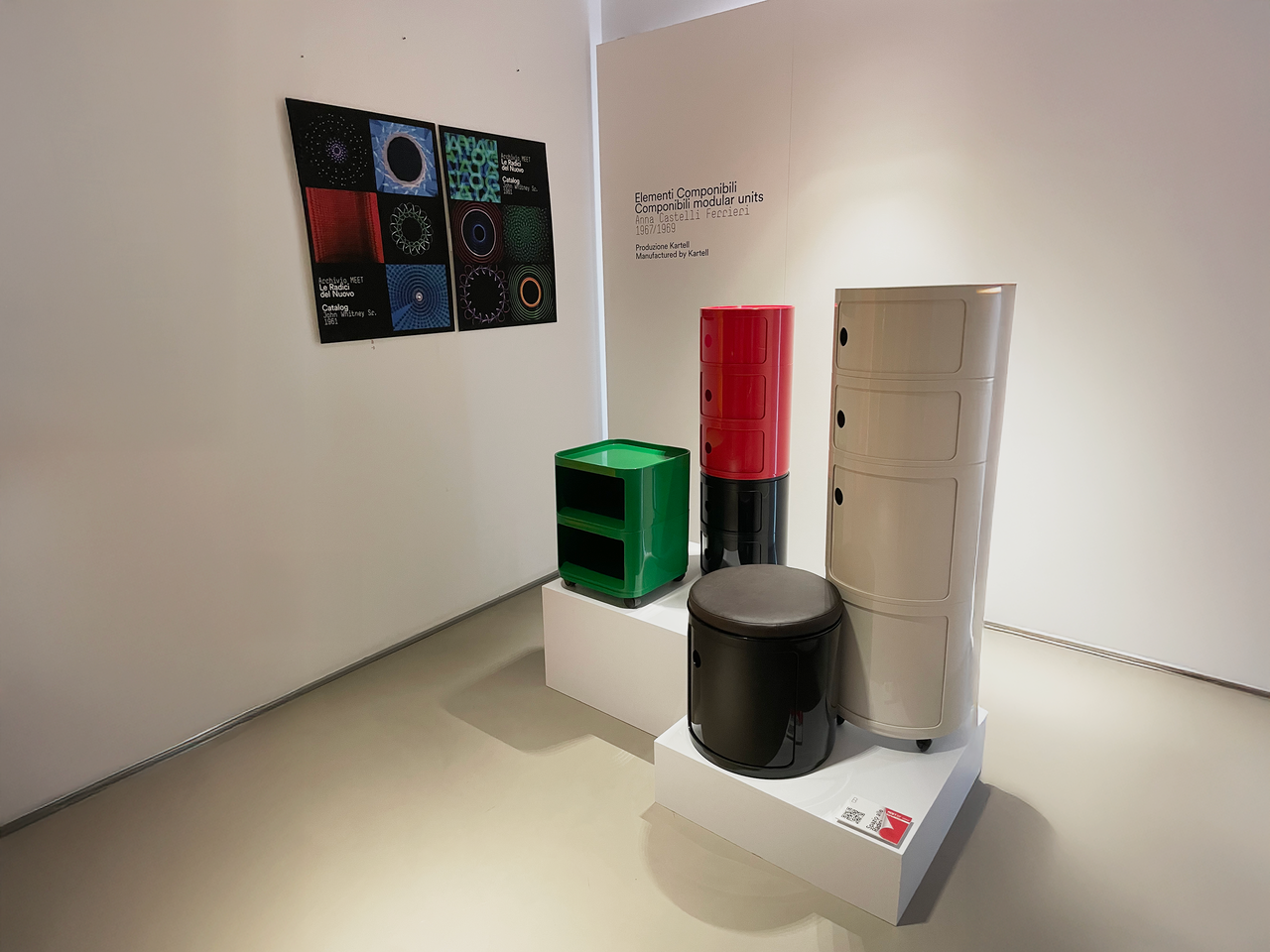
Anna Castelli Ferrieri’s “Componibili” (1967) and John Whitney’s video “Catalog” (1961) are two pioneering examples of how technology can generate new aesthetic languages, marking a turning point in the relationship between design and production.
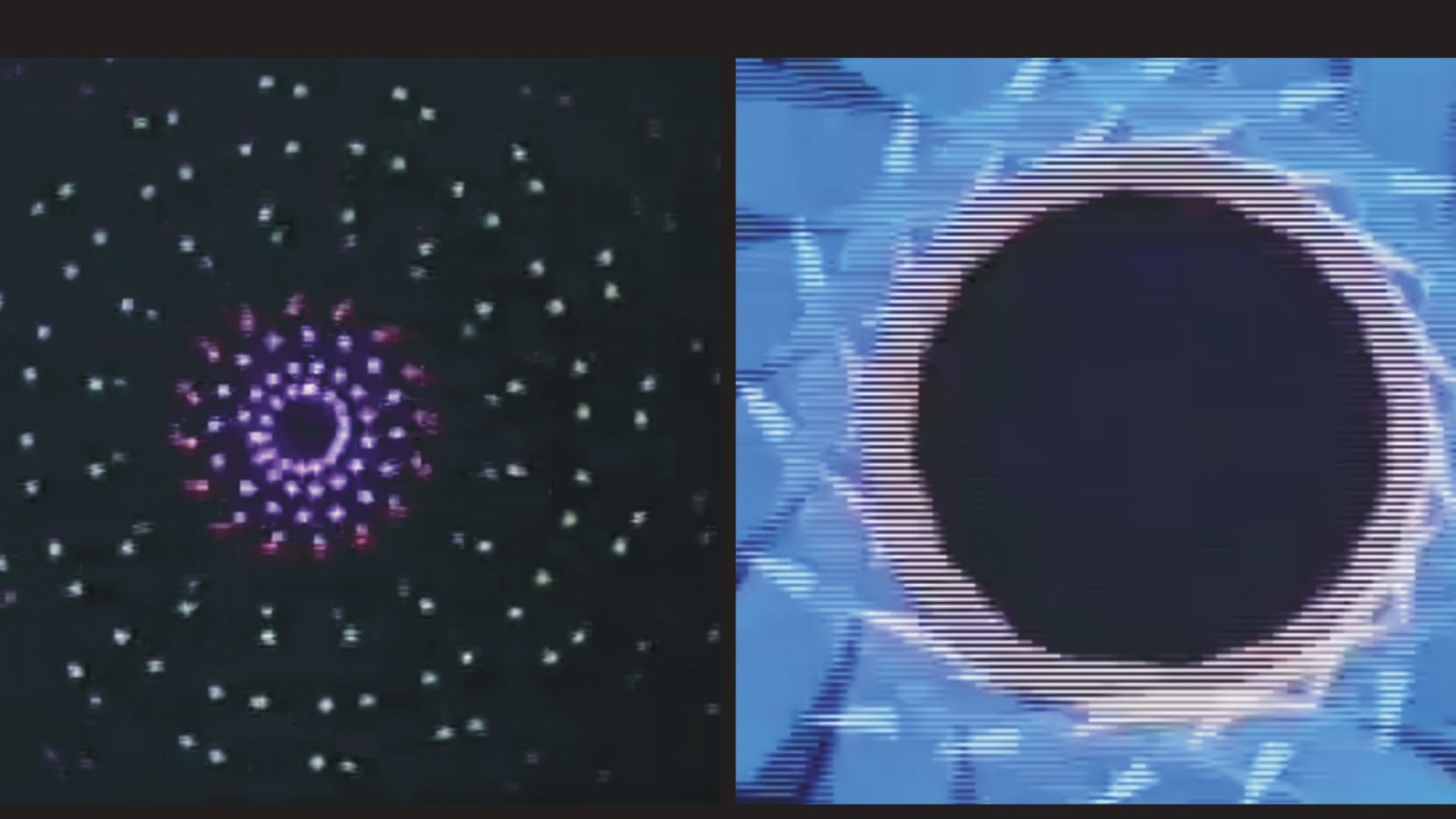
“Catalog” explores the potential of computation applied to the image, transforming mathematical sequences into dynamic visual forms: patterns, movements, and colors that emerge directly from technological processes. Similarly, the “Componibili” were made possible by the use of ABS and injection-molding technology, which allowed for unprecedented formal and productive freedom in industrial design.
In both cases, technology is not merely a means but a condition that enables new design approaches. While John Whitney uses the computer to generate images never seen before, Anna Castelli Ferrieri harnesses the potential of plastic to create a flexible and open modular system.
The “Componibili” also introduce a strong theme related to color, which becomes an integral part of the design: they can be configured as colorful towers capable of defining the space, or as more discreet elements that fit into the margins of the environment, in line with the concept of interstitial furniture.
The dialogue between the two works is also grounded in the theme of freedom: on the one hand, the generative freedom of the computational image; on the other, the compositional freedom offered by the modular system, thereby challenging the very idea of standardization.
2: Power Glove – Ines
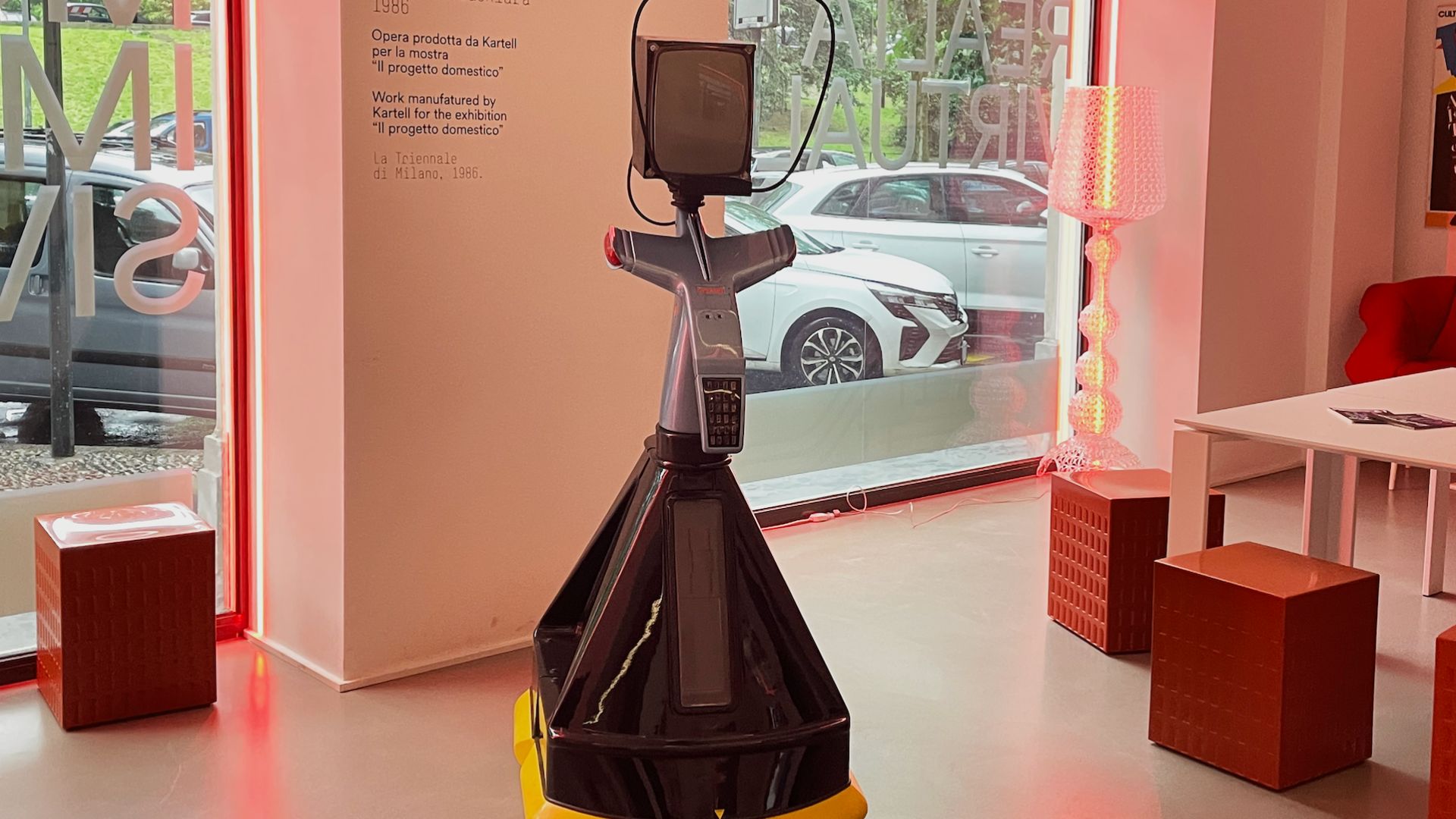
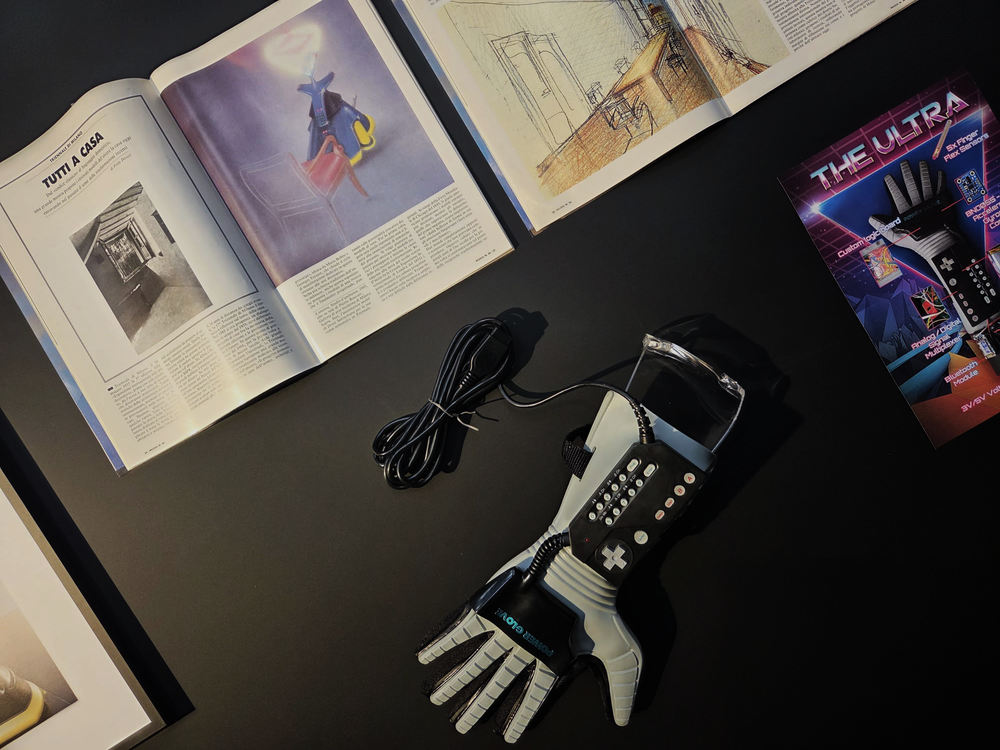
The “Power Glove” gaming glove, housed in the MEET’s Le Radici del Nuovo archive, and the work “Ines,” part of the Kartell Museum collection, designed by Denis Santachiara and produced by Kartell, represent two different interpretations of 1980s technological culture.
The first, developed by Mattel, is one of the most innovative interfaces capable of translating human gestures into access to the digital world, foreshadowing the idea of virtual reality as a space beyond the screen. The second, “Ines,” emerged from research on the themes of living and human-machine interaction, taking the form of a proto-bionic entity that reflects on the relationship between robotics and the domestic sphere. Both works occupy that hybrid space between art and design that characterizes many experiments of the period, sharing the theme of technological anthropomorphism typical of the 1980s, in which machines take on forms and behaviors similar to those of humans. Design itself, during those years, was deeply engaged in questioning the role of smart objects and new modes of interaction. The dialogue between MEET and the Kartell Museum is thus based on the convergence of different fields—art, design, and technological research—united by a shared drive toward experimentation. While the “Power Glove” explores the human body’s access to the digital realm, the “Ines” robot investigates technology’s entry into the domestic sphere and everyday relationships: the dialogue and comparison between the two works offer a coherent vision of the profound transformation of the 1980s, a period in which new forms of relationship between body, object, and technology emerged—relationships that are more relevant today than ever before.
3: Renaissance Dreams – A.I.
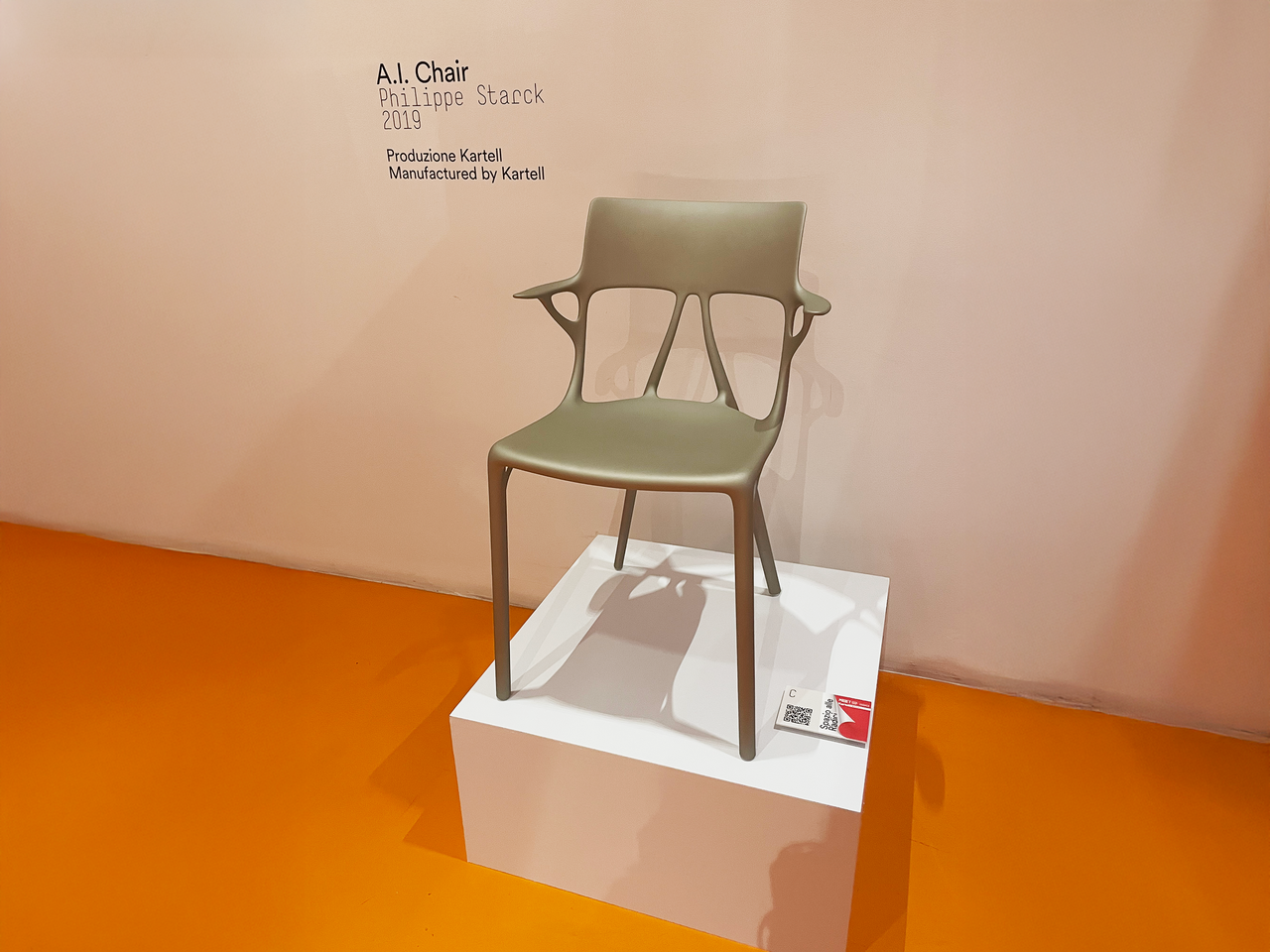
Philippe Starck’s “A.I.” chair (2019), produced by Kartell, and Refik Anadol’s work “Renaissance Dreams” (2019) represent two contemporary applications of artificial intelligence in design and art, respectively, both developed in the same year and within the same technological context.
Thanks to the collaboration between Kartell, Philippe Starck, and Autodesk, “A.I.” was conceived as a chair designed through a process that combines human and artificial intelligence. Starting with parameters related to function, ergonomics, and production methods, the algorithm generates the chair’s form, which is then interpreted by the designer. Made of recycled thermoplastic polymer and produced via injection molding, the chair embodies a sustainable approach, optimizing material use and reducing production time and waste.
“Renaissance Dreams,” an extraordinary work by Refik Anadol presented in MEET’s immersive hall, uses machine learning algorithms to process a vast archive of images and texts from the Italian Renaissance, transforming them into a continuous and immersive visual flow. The work offers a dynamic vision of cultural memory, in which data is translated into machine-generated forms, colors, and movements.
The dialogue between the two works highlights how artificial intelligence is becoming a true design and creative tool. In both cases, form is no longer determined exclusively by the artist but emerges from a collaborative process with the algorithm: on the one hand, in the definition of an industrial object; on the other, in the construction of an image in constant transformation.